Skip to product information
1 of 8

Asante Boutique Coffee Roasters

Specialty Coffee from Costa Rica - Central Valley - Red Honey

Specialty Coffee from Costa Rica - Central Valley - Red Honey

Regular price 19,90€
Regular price Sale price 19,90€
Sale Sold out
Taxes included. Shipping calculated at checkout.
Roast
Weight

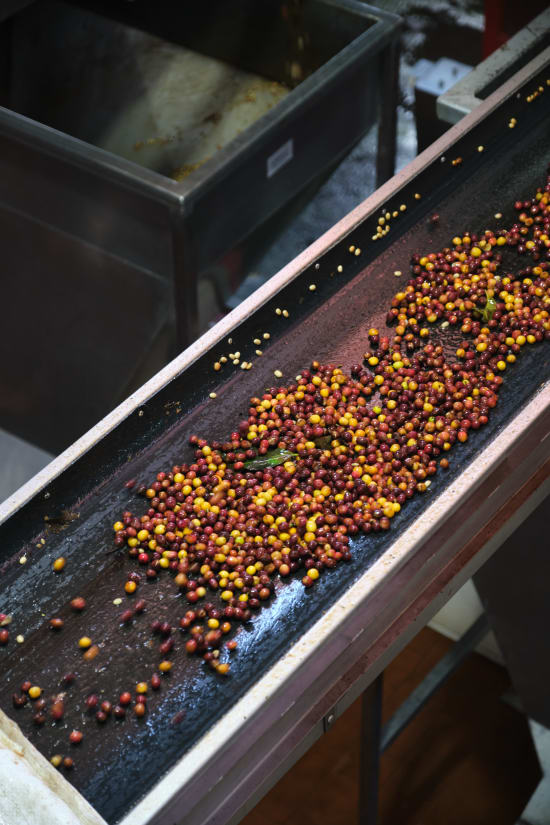
Oscar and Francisca Chacón are third-generation coffee producers, but coffee isn't just in their family heritage: it's also in their hearts and souls. In 2005, after years of delivering their coffee cherries to a cooperative at market price, they decided to join the new "micromill revolution" and buy their own pulper to have more control over the quality and price they received for their lots. "At first, we didn't know what we were doing," explains Oscar. "We were just experimenting."

This experimentation led us to some of the most exciting new flavor profiles we've ever tasted: Now, the Chacons produce a wide range of Honey Process coffees, modulating the drying time to create different effects in the cup. Necessity spurred further innovation for the family when an earthquake in 2008 knocked out electricity and water in their area during harvest. Unable to use pulpers or wash the mucilage to produce washed batches, Francisca drew inspiration from her knowledge of coffee production in Africa and quickly built raised beds on the property.

Origin: Costa Rica
Region: Central Valley
Producer:- Oscar & Francisca Chacón
Variety: - Catuaí, Cockatiel
Altitude: -1600m
Processing Method: - Red Honey

Preparation suggestion (Brewing)


The Cup
Coffee with praline notes, with smooth flavors of brown sugar and dried apple, balanced by an acidity and a slight candy sweetness.

View full details

Costa Rica

COSTA RICA
As the first Central American country to fully establish a coffee industry, Costa Rica's coffee history is long and full of great economic significance. Coffee was planted in Costa Rica in the late 18th century, but it wasn't until the 1820s that it became one of the country's major agricultural exports. In 1846, national production increased considerably with the completion of a main road to Puntarenas, allowing farmers to more easily transport coffee from their farms to market in oxcarts – which remained the way most small farmers transported their coffee until the 1920s. In 1933, the national coffee association, Icafe (Instituto del Café de Costa Rica), was created as an NGO aimed at assisting in the agricultural and commercial development of Costa Rica's coffee market. It is funded by a 1.5% export tax on all Costa Rican coffee, which contributes to the organization's $7 million budget, used for scientific research on Arabica genetics and biology, plant pathology, soil and water analysis, and oversight of the national coffee industry. Among other things, Icafe exists to ensure that contractual terms for Costa Rican coffee guarantee that the farmer receives 80% of the FOB price ("free on board," the point at which ownership and price risks are transferred from the farmer/seller to the buyer).
Although Costa Rica contributes less than 1% of the world's coffee production, it has a strong reputation for producing relatively good, albeit often mild, quality coffee. One way Costa Rica differentiates itself among coffee-producing nations is through the diversity of profiles in its growing regions, despite the country's relatively small geographic size. Tarrazú is perhaps the most famous of the regions: its high altitudes contribute to the crisp acidity of its coffees. The West Valley, known for its high percentage of Cup of Excellence winners, abundantly cultivates both the specific Costa Rican varieties, Villa Sarchi and Villa Lobos, as well as some of the more "experimental" varieties that have arrived here, such as SL-28 and Gesha. Tres Ríos coffee has a reputation for having a smoother, milder profile – perhaps more "easy to drink" with caramel sweetness and soft citrus notes than the more complex or dynamic Costas available. The Central Valley has some of the most distinct weather patterns in the country, with well-defined wet and dry seasons: We find some of the best natural coffees processed in this region. In recent years, coffee growers have become increasingly interested in using variety selection as another way to stand out in the competitive market: SL-28 and Gesha are becoming more common, and local varieties such as Villa Sarchi (a dwarf Bourbon mutation found near the town of Sarchi) and Venesia (a Calopsita mutation).

Coffee with praline notes, with smooth flavors of brown sugar and dried apple, balanced by an acidity and a slight candy sweetness.

Producer Oscar & Francisca Chacón
Região Central Valley
Variety Catuaí, Cockatiel
Process Washed out
Altitude 1600masl
Organic
Roast Level Light Dark
Brewing suggestion